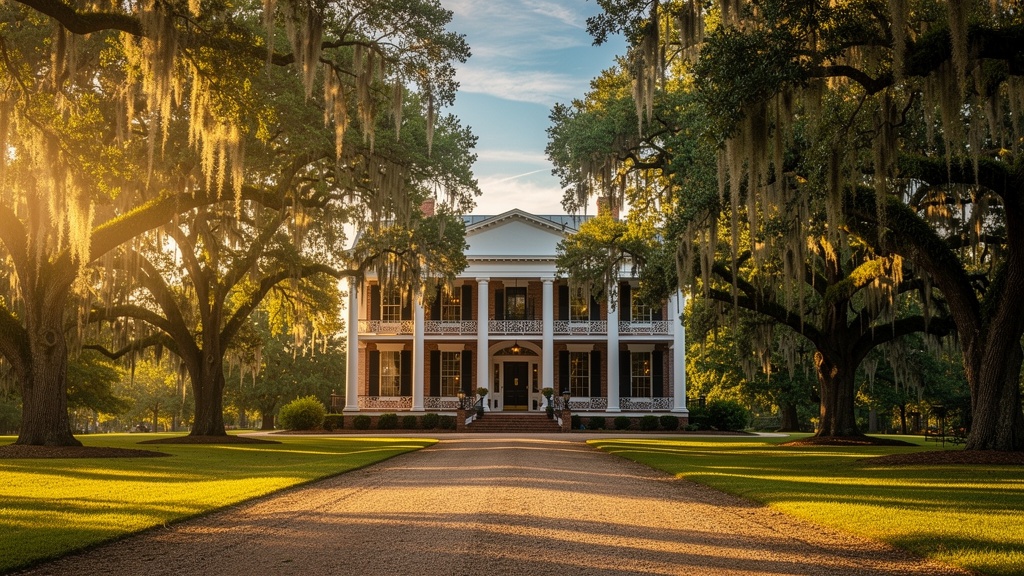
Discover the extraordinary story of the Heart of Dixie — a state of breathtaking natural diversity, profound history, vibrant culture, legendary food, and a Southern spirit unlike anything else in America.
Alabama is a state of extraordinary complexity and surprising depth — a place that rewards the curious traveler with layers of history, culture, and natural beauty that reveal themselves slowly and memorably.
To know Alabama is to know contradiction and complexity at the same time as warmth and beauty. This is a state where the grandest and most formal antebellum mansions sit within a few miles of communities where families have lived close to the land for generations in ways virtually unchanged since the 19th century. It is a place where the most cutting-edge aerospace technology is developed in facilities that neighbor 18th-century Native American mound sites. It is simultaneously the home of some of America's most bitter historical memories and some of its most inspiring stories of human courage and moral progress.
Alabama became the 22nd state of the United States on December 14, 1819, following a relatively rapid settlement of its territory by American colonists primarily from the Carolinas, Georgia, Tennessee, and Virginia in the decade following the Creek Indian War of 1813–1814. The new state's fertile soils — particularly the rich black soils of the central region that came to be known as the Black Belt — made it quickly one of the most productive cotton-growing regions in the world, and the cotton economy brought both prosperity and the institution of slavery that would cast its long, dark shadow over the state's history and that of the entire nation.
Alabama's geography is far more diverse than its size — the state measures approximately 330 miles from north to south and about 190 miles at its widest east-west extent — would suggest. The state is conventionally divided into five physiographic regions, each with its own distinct character, ecology, and human history.
The Tennessee Valley occupies the far north of the state, where the Tennessee River curves through limestone valleys of exceptional agricultural productivity. This region, profoundly reshaped by the Tennessee Valley Authority's massive dam-building program of the 1930s and 1940s, today features a spectacular landscape of lakes, fertile bottomlands, and the dynamic cities of Huntsville and Florence-Muscle Shoals.
The Appalachian Highland region occupies northeastern Alabama, where the ancient Appalachian Mountains — among the oldest mountain ranges on Earth — reach their southernmost extension before finally subsiding into the Piedmont. This is the most dramatically scenic part of Alabama, characterized by forested ridges, river gorges, waterfalls, and the high country of Cheaha and the Talladega National Forest.
The Piedmont Plateau extends across east-central Alabama as a gently rolling transitional zone between the mountain highlands to the northeast and the flat coastal plains to the south. Auburn and Anniston are the major cities of this region.
The Gulf Coastal Plain — by far the largest of Alabama's physiographic regions — sweeps across the southern two-thirds of the state in a broad, gently sloping plain of pine forests, river floodplains, and fertile agricultural land that terminates at the Gulf of Mexico's shoreline.
The Coastal Lowlands form a narrow but ecologically rich fringe along Alabama's southern coast, encompassing the Mobile Bay estuary, the Mobile-Tensaw Delta (one of the largest river deltas in North America), the barrier islands of the Dauphin Island and Fort Morgan Peninsula, and the spectacular beaches of Gulf Shores and Orange Beach.
Alabama's antebellum architectural heritage reflects the state's complex and layered history
Long before European contact, the lands that became Alabama were home to some of the most sophisticated Native American civilizations in North America. The Mississippian Culture — a complex of agricultural, ceremonial, and political societies that flourished across the Mississippi River basin from approximately 800 CE to 1600 CE — built its most populous and politically powerful center at Moundville, a site located on the banks of the Black Warrior River near present-day Tuscaloosa.
At its peak around 1200 CE, Moundville was home to an estimated 3,000 people concentrated within a fortified area of about 185 acres surrounding 26 platform mounds — enormous earthen constructions built by the labor of thousands of workers over multiple generations. The largest of Moundville's mounds rises approximately 58 feet above the surrounding plain and covers an area of nearly three acres, supporting on its summit a wooden temple and the residence of the paramount chief. Moundville functioned as the political, religious, and economic center of a chiefdom that extended its influence across much of what is now central Alabama, with subordinate villages paying tribute to its chief and participating in the complex ceremonial life centered on the site.
The Moundville Archaeological Site, managed by the University of Alabama, preserves this extraordinary landscape largely intact and has developed an excellent on-site museum that contextualizes the archaeological findings within the broader story of Mississippian culture. A walk through the site — particularly at dawn or dusk when the long light casts dramatic shadows across the mound surfaces — is a genuinely moving encounter with the deep human history of the continent.
The first European to enter the Alabama region was the Spanish explorer Hernando de Soto, whose ill-fated expedition traversed the Southeast in 1540–1541 in search of gold and other riches. De Soto's expedition — marked by systematic violence against the Native American peoples it encountered — passed through what is now central Alabama, where it fought the bloody Battle of Mabila against the Choctaw paramount chief Tascaluza in October 1540. The exact location of Mabila has been the subject of intense archaeological debate for decades, but most historians believe it was located somewhere in the Black Belt region of present-day Alabama.
European permanent settlement of Alabama began with the French establishment of Fort Louis de la Mobile near the confluence of the Tombigbee and Mobile rivers in 1702 — a settlement that would move to its current location on Mobile Bay in 1711 and eventually become the city of Mobile. Alabama was successively claimed by France, Britain (which gained it by the Treaty of Paris in 1763 following the Seven Years' War), Spain (which gained West Florida including Mobile in 1780 during the American Revolution), and finally the United States, which gained effective control of the Mobile area in 1813.
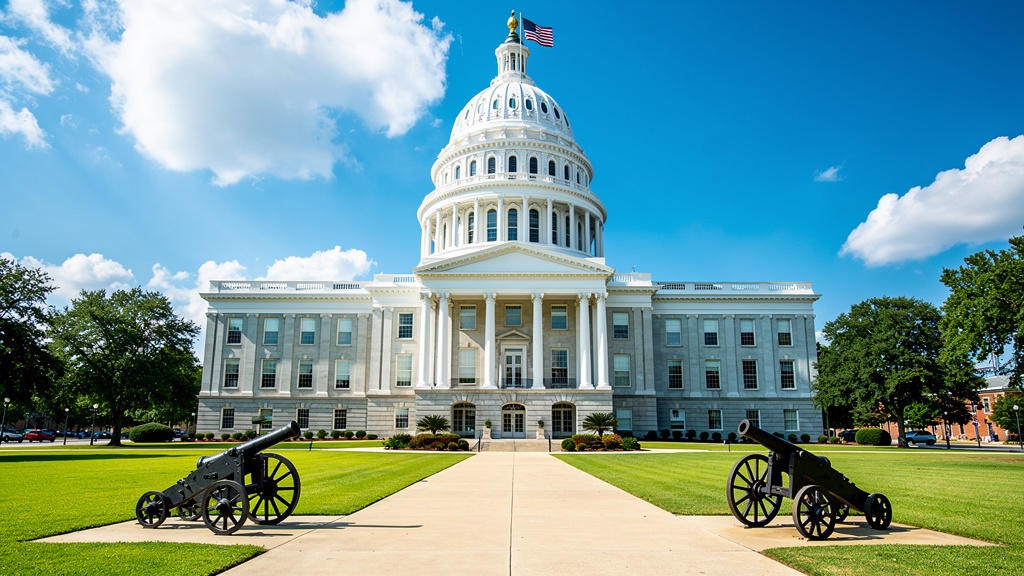
Alabama's role in the Civil War began at the very founding of the Confederacy. Montgomery served as the first capital of the Confederate States of America from February to May 1861, before the government relocated to Richmond, Virginia. Jefferson Davis was inaugurated as the Confederate president on the steps of the Alabama State Capitol — still standing on the same Goat Hill site today — and a brass star on the Capitol's west portico marks the precise spot where Davis stood when he took his oath of office.
The war came to Alabama in force in the spring of 1865, when Union General James Wilson led a cavalry raid through the heart of the state, destroying Selma's vital Confederate arsenal and foundries before moving east to capture Montgomery and the other major Alabama cities. The physical destruction of the Civil War was less severe in Alabama than in Georgia or Virginia, but the social and economic devastation of the Confederacy's defeat — and the profound uncertainties of Reconstruction — created decades of poverty, political instability, and racial tension that shaped the state's history through much of the 20th century.
The Alabama State Capitol in Montgomery — witness to the founding of the Confederacy and the triumph of the Civil Rights Movement
Capital: Montgomery | Largest City: Huntsville | Nickname: Heart of Dixie | State Bird: Yellowhammer (Northern Flicker) | State Flower: Camellia | State Tree: Longleaf Pine | State Fruit: Blackberry | State Freshwater Fish: Largemouth Bass
The story of the American Civil Rights Movement — the most significant domestic moral and political struggle in the history of the United States — is woven into the geography and memory of Alabama more deeply than perhaps any other state. From Rosa Parks' act of quiet dignity on a Montgomery bus to the children who faced police dogs and fire hoses in Birmingham's Kelly Ingram Park to the marchers who crossed the Edmund Pettus Bridge in Selma toward the promise of voting rights, Alabama was the crucible in which the Civil Rights Movement's most decisive battles were fought and won.
The Montgomery Bus Boycott of 1955–1956, which lasted 381 days and ultimately resulted in the Supreme Court's ruling that Alabama's bus segregation laws were unconstitutional, demonstrated for the first time the power of organized, nonviolent mass economic action as a tool for social change. The boycott also elevated a young 26-year-old minister named Martin Luther King Jr. to national prominence, introducing to the world a leader whose vision, eloquence, and moral courage would reshape the United States and inspire liberation movements around the globe.
The Birmingham Campaign of spring 1963 — coordinated by Dr. King and the Southern Christian Leadership Conference with the active cooperation of Birmingham's African American community, including thousands of school children who courageously volunteered to face arrest and police violence — proved to be the decisive turning point that compelled President Kennedy to introduce comprehensive civil rights legislation. The shocking photographs and television footage of Birmingham Police Commissioner Bull Connor's officers using high-pressure fire hoses and police dogs against peaceful, singing demonstrators — including children as young as eight years old — produced an international outcry that made the status quo of segregation politically untenable.
The Selma to Montgomery marches of March 1965 — the culmination of a sustained campaign to secure voting rights for African Americans in the Alabama Black Belt — were the final dramatic act in a struggle that had been building for decades. Bloody Sunday, March 7, 1965, when state troopers attacked 600 peaceful marchers with clubs and tear gas as they attempted to cross the Edmund Pettus Bridge, shocked the nation and the world. The broadcast footage of the attack, seen by millions of Americans on their television sets within hours, created the political moment that made the Voting Rights Act of 1965 inevitable.
Today, Alabama honors this extraordinary history with a network of museums, memorials, and historic sites that collectively constitute one of the most significant civil rights heritage trails in the world. The Birmingham Civil Rights Institute, the 16th Street Baptist Church, Kelly Ingram Park, the Rosa Parks Museum in Montgomery, the Legacy Museum, the National Memorial for Peace and Justice, Dexter Avenue King Memorial Baptist Church, the Edmund Pettus Bridge in Selma, and the Selma to Montgomery National Historic Trail form a circuit of historical sites whose depth and significance rewards multiple visits and extended contemplation.
I have a dream that my four little children will one day live in a nation where they will not be judged by the color of their skin but by the content of their character.
— Dr. Martin Luther King Jr., Washington D.C., 1963 — a minister who led the Montgomery Bus Boycott from AlabamaAlabama's food culture is one of the richest, most distinctive, and most deeply rooted in the American South. The state's culinary traditions draw on an extraordinarily complex mixture of influences: the agricultural traditions of English and Scots-Irish settlers who adapted Old World cooking methods to New World ingredients; the profound contributions of enslaved African Americans whose creativity and expertise in the kitchen effectively created the foundations of what we know as Southern cuisine; the culinary legacies of French, Spanish, and Creole culture in Mobile and the coastal region; and the more recent influences of immigrant communities from Latin America, Asia, and the Middle East who have enriched Alabama's food landscape in the 20th and 21st centuries.
Alabama barbecue occupies a special place in the American barbecue pantheon. While the state participates broadly in the wood-smoked pork tradition of the Deep South, Alabama possesses one hyperlocal barbecue tradition that is unlike anything found elsewhere in the world: the white sauce. Bob Gibson's restaurant in Decatur is generally credited with inventing the preparation — a creamy, tangy, pepper-forward mayonnaise and vinegar-based sauce that is traditionally slathered over smoked chicken and makes no physical sense whatsoever until the moment you taste it, at which point it makes all the sense in the world. Today, white sauce has spread beyond its north Alabama homeland and is recognized nationally as one of the most distinctive regional barbecue traditions in the country.
The Gulf Coast contributes a seafood culture of extraordinary richness. Fresh Gulf shrimp — the sweet, plump, wild-caught shrimp harvested by local boat crews from the waters of Mobile Bay and the nearshore Gulf — are the foundation of a coastal food culture that encompasses everything from elegantly simple boiled shrimp with cocktail sauce to creamy shrimp and grits to the complex, herby shrimp Creole preparations that reflect Mobile's French heritage. Fresh oysters from Bon Secour Bay, oyster reefs in Mobile Bay, and the waters around Dauphin Island are prized by connoisseurs for their distinctive mineral flavor. Gulf red snapper — managed sustainably under federal fishing regulations that have allowed stocks to recover substantially from historic overfishing — is considered by many chefs to be among the finest food fish available in North American waters.
Alabama's contribution to American music history is staggering in its breadth and depth. The state played a fundamental role in the creation of the blues — that most quintessentially American of musical forms — in the river towns and rural communities of the Black Belt and Tennessee Valley regions in the late 19th and early 20th centuries. W.C. Handy, the man who would become known as the "Father of the Blues," was born in Florence, Alabama, in 1873 and described hearing the blues in its raw, proto-form at a train station in Tutwiler, Mississippi, as a young man. His compositions, including "St. Louis Blues" and "Memphis Blues," brought the form to national and eventually international audiences.
The Muscle Shoals Sound — the unique musical alchemy that emerged from the Fame Studios and Muscle Shoals Sound Studio recording operations in Sheffield and Muscle Shoals during the 1960s and 1970s — produced some of the most celebrated recordings in the history of American popular music. Artists including Aretha Franklin (who recorded her landmark "Respect" and "Chain of Fools" here), the Rolling Stones (whose Sticky Fingers sessions produced some of their finest work), Wilson Pickett, Percy Sledge, Paul Simon, Lynyrd Skynyrd, and literally hundreds of others came to the Muscle Shoals area to record, drawn by the extraordinary rhythm section known as the Swampers and by the indefinable quality of the music that seemed to emerge naturally from the place and its people.
Alabama's festival culture celebrates the state's extraordinary food traditions with community gatherings throughout the year
Alabama has produced a remarkable tradition of self-taught and folk art that has achieved national and international recognition and continues to draw collectors, scholars, and art enthusiasts from around the world. The small community of Summerville in Chattooga County is home to Lonnie Holley — one of the most celebrated and complex artists working in America today — whose sculptural environments and mixed-media works have been exhibited in major museums and galleries worldwide. The Black Belt town of Eutaw is a center for quilting traditions of African American origin that have been recognized as significant contributions to American craft heritage. The annual Kentuck Festival of the Arts in Northport — held each October — has been one of the most important gatherings of American folk, outsider, and self-taught art for over 50 years, drawing artists and collectors from across the country to a neighborhood whose tree-lined streets become, for one weekend each year, one of the great outdoor art exhibitions in the United States.
Alabama's calendar is filled year-round with festivals, celebrations, and community events that reflect the state's rich cultural diversity and its people's irrepressible enthusiasm for gathering, sharing food, and celebrating life together. The National Shrimp Festival in Gulf Shores each October draws hundreds of thousands of visitors for four days of fresh Gulf seafood, live music, and art exhibitions along the beachfront. The Alabama Peach Festival in the Chilton County town of Clanton celebrates the extraordinary quality of the state's summer peach crop — grown in the red clay soils of central Alabama and considered by connoisseurs to rank among the finest peaches in the world — with a weekend of tastings, cooking competitions, and agricultural celebrations in July.
The Birmingham International Film Festival, Huntsville's Big Spring Jam music festival, the Mardi Gras celebrations of Mobile (the oldest continuous Mardi Gras tradition in North America), the Azalea Trail Run and Festival in Mobile (featuring the famous Azalea Trail Maids in their magnificent antebellum ball gowns, a tradition dating to 1929), the Watermelon Festival in Cullman, the Barbecue and Blues Festival in Sheffield — the list of Alabama festivals and celebrations is genuinely remarkable in its variety and cultural richness.
No discussion of Alabama culture would be complete without addressing the role of college football — and specifically the rivalry between the University of Alabama's Crimson Tide and Auburn University's Tigers — in the social and cultural life of the state. College football in Alabama is not merely a sport; it is, as observers from outside the state routinely note with equal parts bewilderment and admiration, something closer to a civic religion, a primary vehicle of community identity, and a powerful social organizer that touches virtually every aspect of public life from September through January.
The intensity of Alabama football fandom is rooted in a specific historical and sociological context. Alabama was, for much of the 20th century, a state with relatively limited national visibility and modest economic means, and the extraordinary success of its college football programs — particularly the University of Alabama under coaches Frank Thomas, Bear Bryant, Gene Stallings, and Nick Saban — provided a source of pride and distinction that resonated deeply with populations that had few other reliable sources of national positive attention. The Crimson Tide's 18 national championships (as of 2024) and Auburn's two have given Alabamians bragging rights on a national stage that transcend the sport itself.
Alabama has produced writers of extraordinary talent and significance. Harper Lee, born in Monroeville, Alabama, in 1926 and educated at the University of Alabama, created in "To Kill a Mockingbird" one of the most beloved and influential novels in American literary history — a work that has shaped the moral imagination of millions of readers worldwide and continues to sell hundreds of thousands of copies each year. The Truman Capote Connection — Capote grew up as Lee's neighbor in Monroeville and clearly served as the inspiration for the character of Dill Harris in the novel — adds another layer of literary significance to this small southwest Alabama town, which celebrates its literary heritage with an annual festival and the Monroe County Heritage Museum.
Fannie Flagg, Zelda Fitzgerald (native of Montgomery), Winston Groom (author of "Forrest Gump"), Rick Bragg, Sena Jeter Naslund, and many other significant writers have been shaped by their Alabama roots and have used the state's landscape, history, and people as the raw material for literature of enduring quality. The Birmingham-based literary community has developed considerable vitality in recent decades, supported by institutions including the Alabama Writers' Forum, the Alabama Book Festival, and the remarkable Birmingham Public Library's extensive Southern literary collections.
Alabama's antebellum architectural heritage speaks to the deep roots of Southern culture in the Heart of Dixie
Plan a music heritage tour of Alabama: Start in Florence at the W.C. Handy Birthplace Museum, visit the legendary FAME Studios in Muscle Shoals, check out the Muscle Shoals Sound Studio, then drive south to Birmingham for its vibrant live music scene. Don't miss the Alabama Music Hall of Fame in Tuscumbia.
Helen Keller (Tuscumbia) · Hank Williams (Georgiana) · Nat "King" Cole (Montgomery) · Harper Lee (Monroeville) · Rosa Parks (Tuskegee) · Jesse Owens (Oakville) · Joe Louis (LaFayette) · Lionel Richie (Tuskegee) · Bo Jackson (Bessemer) · Courteney Cox (Birmingham)
Alabama's economy has undergone a remarkable transformation over the past four decades, shifting from its historic dependence on agriculture, steel, and textile manufacturing toward a more diversified economic base that today encompasses aerospace and defense, automotive manufacturing, healthcare and biotechnology, technology services, and a growing tourism industry. The transformation has been neither entirely smooth nor uniformly distributed across the state, and significant economic disparities remain — particularly in the historically impoverished Black Belt region — but the overall trajectory of Alabama's economy in the 21st century has been one of diversification and growth that has surpassed the expectations of many observers.
The automotive industry's arrival in Alabama beginning in the 1990s — when Mercedes-Benz chose a site near Tuscaloosa for its first American manufacturing plant — fundamentally changed the state's economic profile. Today, Alabama is home to major manufacturing operations for Mercedes-Benz, Honda, Hyundai, and Toyota, along with hundreds of supplier plants that collectively make automotive manufacturing one of the largest sectors of the state's economy. The BMW facility in nearby Spartanburg, South Carolina, has extended the automotive manufacturing cluster's influence into the broader region, creating an "Auto Alley" that stretches across much of the American Southeast.
The aerospace and defense sector, centered on Huntsville's Redstone Arsenal and the surrounding ecosystem of government agencies, defense contractors, and aerospace companies, is another pillar of Alabama's modern economy. Huntsville is home to the US Army's missile defense programs, NASA's Marshall Space Flight Center, the FBI's operational technology division, and major operations for Boeing, Raytheon, Lockheed Martin, Northrop Grumman, and dozens of other high-technology companies. The area has been ranked repeatedly as one of the fastest-growing technology hubs in the American Southeast.
Perhaps the most consistently reported observation of travelers visiting Alabama for the first time — cutting across all demographic categories, political affiliations, and geographic origins — is the genuine warmth and hospitality of the state's people. Southern hospitality is sometimes dismissed as a stereotype or a marketing cliché, but visitors to Alabama consistently find it to be a lived reality: strangers who greet you on the street, shopkeepers who spend twenty minutes helping you find what you need, hosts who insist on feeding you whether you're hungry or not, and a general social culture of inclusion and welcome that can feel disorienting to visitors from more anonymized urban environments.
This hospitality is rooted in genuine cultural values — a belief in the importance of community, family, and shared obligation to neighbors that has deep historical roots in the rural Alabama culture from which most Alabamians' family histories ultimately derive. It is expressed in the tradition of taking food to neighbors in times of illness or loss, in the culture of front-porch conversation, in the church-based community networks that remain among the most important social institutions in much of the state, and in the spontaneous generosity toward strangers that travelers regularly encounter and rarely forget.
Alabama's biodiversity is one of its most extraordinary and least-publicized attributes. The state harbors the richest diversity of freshwater fish, freshwater mussel, and crayfish species of any comparable area in North America — a direct result of the state's complex and ancient river systems, which have acted as refugia for aquatic species through multiple climate shifts over millions of years. With over 300 native freshwater fish species, approximately 170 species of freshwater snails, and nearly 175 species of freshwater mussels, Alabama's rivers and streams constitute a biological treasure of global significance.
The state's terrestrial biodiversity is equally impressive. Alabama's forests — encompassing longleaf pine savannas in the south, mixed hardwood-pine forests across the central regions, and Appalachian mixed hardwood communities in the north — support over 3,500 plant species, 400+ bird species, and a diverse mammal fauna that includes black bears, mountain lions (rarely), white-tailed deer, wild turkey, river otters, and beaver. The coastal and wetland habitats of the Mobile-Tensaw Delta — one of the most biologically diverse places in North America — support an extraordinary range of reptiles, amphibians, and invertebrates, including several species found nowhere else on Earth.
Major cities and most tourist destinations have excellent cell coverage (AT&T, Verizon, T-Mobile) and reliable Wi-Fi. Some rural areas, particularly in north Alabama's mountains and the Black Belt, may have limited connectivity. Download offline maps before venturing into remote areas.
Major airports at Birmingham (BHM), Huntsville (HSV), and Mobile (MOB). I-20, I-59, I-65, and I-85 provide highway access. Amtrak's Crescent route serves the state.
Full range from luxury resorts (Lodge at Gulf State Park, Grand Hotel Marriott in Point Clear) to charming historic B&Bs, state park lodges, and excellent chain hotels throughout major cities.
Humid subtropical climate. Hot, humid summers (85–95°F). Mild winters (40–55°F in most areas). Spring and fall are excellent for all outdoor activities.
Alabama offers excellent value. Dining is generally more affordable than comparable cities in the Northeast or on the West Coast. State park entrance fees are modest. Most historic sites are free or low-cost.
A rental car is essential for most Alabama travel. The state is best explored by road. Rideshare services (Uber, Lyft) are available in all major cities but limited in rural areas.
Alabama Tourism Department (tourism.alabama.gov) provides excellent planning resources. Alabama State Parks app for campsite reservations. Local visitor centers in every major city.